

Portable Cabin Prices: Karmod Container Cabins by Layout and Size
Karmod container cabin prices by layout and size, what electrics, heating and fittings add, what the listed price leaves out, and how to get a firm quote.
Guide
Car parks, city building sites, residential forecourts and venues: how to size a security hut for a tight urban pitch, plan its delivery and power, and decide whether armour is needed.
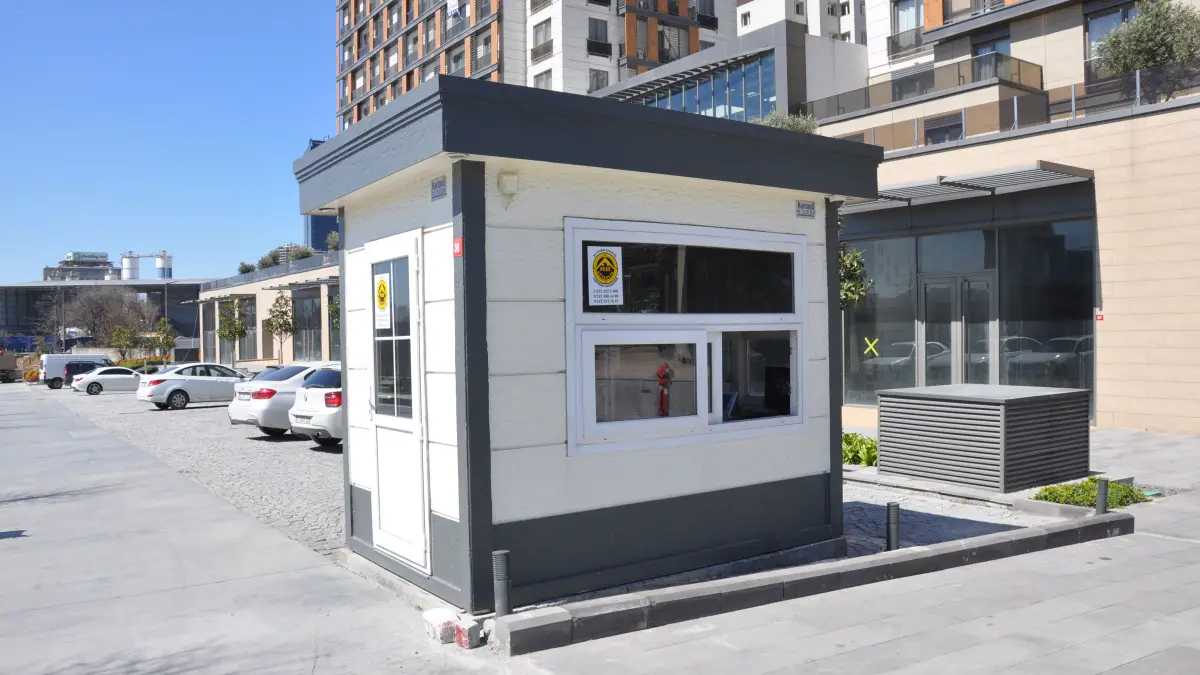
Security huts in towns and cities do a harder job than the same cabin on an open industrial estate. The pitch is smaller, people walk past all day, the street is busy on delivery day and the hut becomes part of someone's frontage. This guide covers where urban huts are used, siting, delivery and what Karmod's ranges cost.
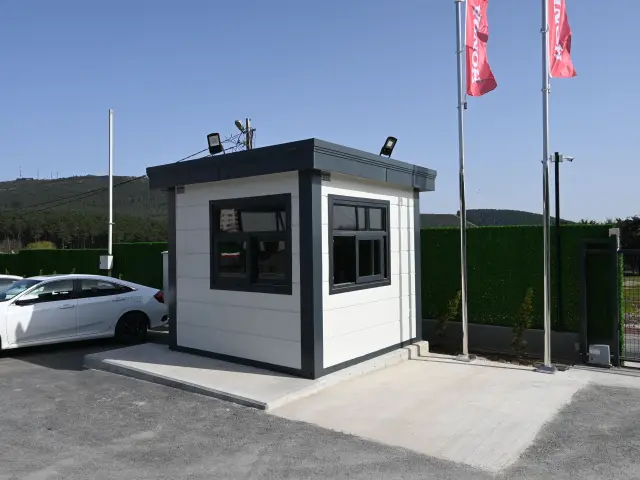
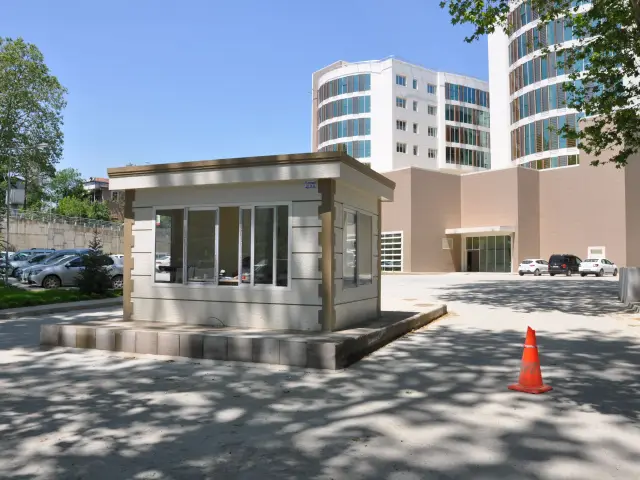
Attendants at barriers and pay stations need shelter and a view of every vehicle coming in. In Karmod's project gallery, a stone-effect MetroCity booth in a hospital car park gives staff a sheltered post with clear sight lines across the entrance, and a MetroCity gatehouse controlling the vehicle entrance to a car showroom carries roof-mounted floodlighting and cameras for after-hours cover. For attendant posts, see our car park and valet cabins.
On a city-centre build, the gate is squeezed between the hoarding, the pavement and the delivery route, and it may move as the job progresses. Light cabins help: Karmod's insulated panel cabins weigh from 100 kg and GRP cabins from 280 kg, and cabins can be lifted again and re-sited when the site plan changes.
Here the hut is part reception, part control point. It has to watch the footway and the car park entrance, and residents see it every day. At the Double Park development, a MetroCity cabin on the forecourt staffs the pedestrian and vehicle approach to the residential towers.
At arenas, theatres and stadiums the hut usually works a service gate or staff entrance rather than the public front. Karmod's insulated panel cabins are used at events and public venues as ticket or control cabins for a fixed run of dates, and can be lifted out again when the layout changes between events.
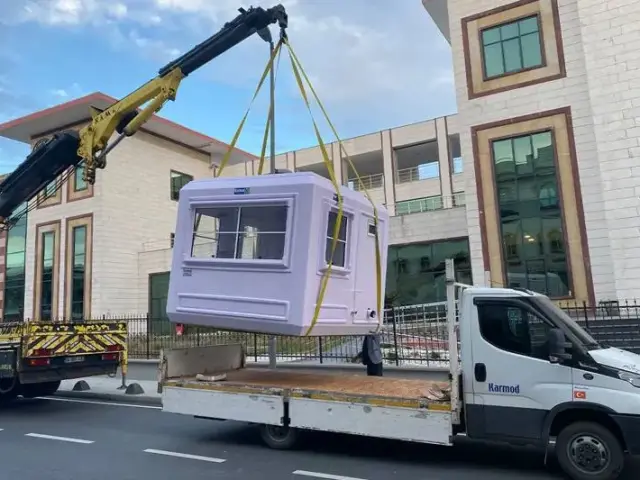
The cabin arrives finished on a lorry and is lifted onto its base by a lorry-mounted crane (often called a HIAB), a mobile crane or a forklift, depending on its weight and the site. Karmod security cabins range from 100 kg to 10,500 kg. The lighter the cabin, the smaller the crane that can lift it, and the further a given crane can reach with it, which matters when the pitch is behind a wall or hoarding. Before the formal quote, we check the drawing, the delivery route and the offload equipment, so tell us:
If the lorry or crane has to stand on, or lift over, a public road or pavement, you may need permission first:
Suspending parking bays so the lorry has somewhere to stand is usually a separate application, and a road closure is another, with a longer lead time. Fees and notice periods vary, so speak to the highway authority before you fix a delivery date: the council's highways or roads team in England, Wales and Scotland, or DfI Roads in Northern Ireland.
On a tight site, height and weight matter as much as price: they decide what fits under a canopy or deck and what machine lifts it in. Prices are per cabin and exclude VAT, delivery and offloading.
| Range | Smallest footprint | Height | Weight | Price from | City pitch it suits |
|---|---|---|---|---|---|
| Insulated Panel Cabin | 1.10 × 1.10 m | 2.35 m | 100–380 kg | £2,290 + VAT | Barrier islands and gates that move |
| GRP Cabin | 1.50 × 1.50 m | 2.40–2.45 m | 280–650 kg | £3,890 + VAT | Exposed gates re-sited between phases |
| MetroCity Modular Cabin | 1.40 × 1.40 m | 2.75 m | 700–1,400 kg | £5,595 + VAT | Forecourts and car parks in public view |
| KompoCity Composite Cabin | 1.40 × 1.40 m | 2.75 m | 850–1,900 kg | £6,890 + VAT | Frontages where the hut should match the building |
| Bulletproof Security Cabin | 1.50 × 1.50 m | 3.00 m | 3,000–10,500 kg | £39,900 + VAT | Posts where an assessment calls for armour |
Every size up takes more of the forecourt, a bigger base and a heavier lift, so choose the smallest footprint that fits the role. If couriers or visitors come to the window, allow space for them to stand clear of the footway.
For a barrier island or a construction gate, the insulated panel cabin is the lightest lift. Where residents or customers see the hut every day, the MetroCity cabin has Betopan cladding that resists fading, cracking and peeling outdoors, and KompoCity's aluminium composite skin gives a smooth, straight-lined frontage. For a side-by-side comparison of the five ranges, read choosing a security hut, and see sizes by role on our security huts and gatehouses page.
A city address is not a reason for armour on its own. Armour is for a post where a formal security assessment calls for ballistic protection for the person on duty. Karmod's armoured range is intended for sites such as government building entrances, courts, embassies, cash centres and data centres, and for temporary control points at stadiums and arenas.
On a tight urban plot, weight is the bigger planning job. The smallest armoured cabin, 1.50 m × 1.50 m, is £39,900 + VAT and weighs 3,000 kg, against 1,400 kg for the largest MetroCity cabin. A forecourt or podium over a basement may not take that load, so ask a structural engineer before you fix the position, and expect a larger crane than a lighter hut needs. Our high-security cabins page lists every size and price.
Every Karmod security cabin range is insulated. MetroCity cabins have electrics, lighting and sockets fitted at the factory, and KompoCity interiors can be prepared with electrics, lighting, sockets and ventilation before delivery. On panel and GRP cabins the electrical pack and wall heater are priced options: for example, a 1.35 m × 1.35 m insulated panel cabin (£2,690 + VAT) with the electrical pack (£375 + VAT) and a wall heater (£225 + VAT) comes to £3,290 + VAT, excluding delivery and offloading. Customised electrics for these two ranges are priced on application, so tell us what equipment the hut must power.
On a forecourt the supply often comes from the adjoining building, which can mean ducting under paving, so agree the cable route with the building owner early and have a qualified electrician make the connection. Avoid running a temporary cable across a footway, where it becomes a trip hazard.
Send us these details through our contact page or call 0116 403 0143, Monday to Friday, 8:00 to 18:00. Sending a request does not commit you to anything.
Not without the highway authority's agreement, and it is rarely the right spot. Paving that runs up to your building line can still be public highway, and in England and Wales wilfully obstructing free passage along a highway without lawful authority or excuse is an offence under section 137 of the Highways Act 1980. Ask the council's highways team where the adopted highway ends before you fix the pitch. In Scotland ask the council as roads authority, and in Northern Ireland ask DfI Roads.
Check the clear headroom first. Karmod insulated panel cabins are 2.35 m tall, GRP cabins 2.40 m to 2.45 m, and MetroCity and KompoCity cabins 2.75 m. A crane cannot lift a cabin under a deck, so it usually has to travel in on a forklift, which needs clearance above the cabin and a firm, level route. Send us the headroom at the entrance and along the route, and the formal quote will confirm the offload equipment.
As early as you can, because notice periods vary between highway authorities. One English county council, for example, asks for crane permit applications at least seven working days ahead, and six weeks ahead where a road closure is needed. Parking suspensions have their own forms and notice periods. In Northern Ireland, ask DfI Roads rather than the council. Agree in writing who will apply for each permission before you fix the delivery date.
Check the access conditions first. In England, planning permission for a new or altered access often carries a condition keeping its visibility splays clear, so drivers pulling out can see along the road. One county council's standard wording keeps splays clear of any obstruction between 0.6 m and 2.0 m above ground level. Karmod security cabins are 2.35 m to 3.00 m tall, so a hut placed in a splay would block it. Check the decision notice and approved drawings for the access, and confirm with your local planning authority before you fix the pitch. Elsewhere in the UK, ask your planning authority.
Karmod container cabin prices by layout and size, what electrics, heating and fittings add, what the listed price leaves out, and how to get a firm quote.
The full welfare checklist for GB construction sites under CDM 2015: what each facility involves, who must provide it from day one, and the Karmod units that cover it.
Portable cabin, container office or modular building? What each term means, how Karmod's units are built, and which type suits a site, a gate or a garden.
Talk to our UK team
Tell us what the building is for and where it is going. We will suggest a unit, check delivery and send a formal quote.

